Wednesday, October 22, 2014

How TaylorMade’s marketing slayed Callaway and saved golfers money

 via GolfWRX - Golf news, equipment, reviews, classifieds and discussion


I’m going to start this one with a disclaimer. Understand that I have no motive outside pr

Presenting an accurate historical accounting.

Back in March of 2012, TaylorMade-adidas purchased Adams Golf. At the time, Adams was a public company and the decision to sell had been made by a sufficient number of shareholders that a positive vote to a good offer was decided in advance. At the time I was a minor shareholder, so my votes had no impact on the decision and I voted with the majority. Further, I had no relationship with TaylorMade and to this day I have never met any executive within their organization.

Now the story.

Back in the early 1980′s, the golf equipment industry was all about Ping. The company had effectively replaced the old guard — Wilson, McGregor, Spalding and Powerbilt — as the hot brand. Ping’s EYE-2 irons became the best-selling iron in the industry and the introduction of investment in casting and perimeter weighting led the way for thinking about designs far advanced of blade irons and persimmon woods.

In the mid 1980′s, a marketer with a passion for golf by the name of Ely Callaway acquired a company called Hickory Sticks, which in 1988 became Callaway Golf. He attracted investors, brought out irons with no hosels and eventually released an oversize titanium driver called the “Big Bertha” after the famous German howitzer.

Here’s a bit of insider history. When tested, the first Berthas didn’t perform as well as hoped. They tended to go low and right (not unlike the infamous oversized Bridgestone “J” driver designed for Jumbo Ozaki) when folks finally got them. The Callaway folks noticed that their 11-degree driver worked fine; it was the 9-degree model that was giving golfers problems. The fix? When the clubs made it into production, the 9-degree driver actually had about 11 degrees of loft and the 11 degree had about 13 degrees of loft. Aided by strong marketing, the clubs were a huge success spawning line extensions that went on for years.

Here’s another digression: The reason the 9-degree Big Bertha driver (and the J driver) didn’t perform very well was that its center of gravity (CG) was too close to the face. That made it very low spinning compared to what golfers were used to and also very hard for average golfers to square the face. Does the low-spin, high-loft story sound familiar in today’s marketplace?

I started in the golf equipment business in 1987 and registered somewhere below obscurity until a club called “Tight Lies” became popular in the late 1990′s. Along the way, I got to know Ely Callaway. In fact, we had an informal exchange of phone calls on Friday afternoons.

Ely told me that when he entered the golf industry he was not impressed with the marketing he saw. Further, he discerned that more distance was the great elixir to the public and that a combination of a strong tour staff, creative marketing and innovative product would allow his company to dominate. And boy did it ever. All respect to Ping (one of my all-time favorite companies), it became an also-ran with everyone else as Callaway set new standards for sales volume at previously unheard of high retail prices, generating margins held in envy. Cleveland and Cobra had some good numbers, but nothing close to Callaway.

Now ask yourself a question. You have just been given the CEO job at a competing company. Your dream comes true. You face this 400-pound gorilla called Callaway that has more money, huge market momentum and unheard of market acceptance. How do you compete? Do not say that you’ll make great product and sell it cheaper. The product can’t be just cheaper. It will have to be much cheaper — like half — and you’ll have to spend a ton of marketing money to convince the public that it’s as good. That’s not exactly a thrilling message. This is a recipe for going broke, as history teaches.

That CEO’s name was Mark King. He was the vice president of golf ball sales for Callaway and he got recruited to TaylorMade as CEO. He had Adidas money behind him and a seemingly impossible challenge. He came up with a unique strategy — speeding up the new product release cycle — and figured that Callaway couldn’t react to his speed, or at least by the time Callaway did TaylorMade would have already shifted momentum. He got Addidas to underwrite a huge presence on Tour because without it, no strategy would have worked. It takes big money as it becomes a bidding process for faces on television.

The strategy succeeded beyond most people’s dreams, maybe even King’s. He not only disrupted Callaway; he disrupted all the companies. The low-price market disappeared, and consumers could now buy discounted product that was only a few months old. This was highly preferable to buying products from low-price brands. TaylorMade became the volume and innovative leader and along the way attracted millions of loyal customers. You see, without this strategy everything would probably still be full retail price like it was before.

The problem is that the strategy can’t endure forever. Every year, the market inventories increased and along came the storm. We have to realize that since 2000 golf has lost some 40 percent of the folks who pay 71 percent of all expenses including equipment. Retailers sniffed the impending adjustment and dumped inventories, cut back personnel and reduced buys. Some decided golf equipment was a lousy business and looked to other products.

Momentum shifted, business magazines wrote stories about the fall of the golf industry and nobody was optimistic. They still aren’t.

And you, Mark King, took heat as TaylorMade’s sales dropped significantly and got “promoted” upstairs. Members of the golf community including consumers and internet readers made you out to be a bad guy. The truth? One can argue that the speeded up cycle had to crash that there was no other way to stop it. Maybe, maybe not, but King did a great job fighting the Callaway juggernaut and saving consumers money along the way.

For those who complain about equipment prices, here’s a bit more history. In 1995, three woods and nine irons from Callaway retailed for $2325! Now assume that King hadn’t been successful with his strategy, factor in normal price increases and consider what golf equipment retail would be like today. The long-term strategy may have been flawed and the drop in play hurt, but over the years Mark King saved consumers a lot of money.


Tuesday, October 21, 2014

Tiger back to hitting full shots

 via GolfWRX - Golf news, equipment, reviews, classifieds and discussion


by    |   October 20, 2014

Tiger Woods is on the mend and has resumed hitting full shots, according a story from USA Today.

“The doctors said he could hit golf balls again, and he’s listening to his doctors and to his body,” Woods’ agent, Mark Steinberg, told USA Today Sports on Monday. “He will keep listening to his doctors and body.”

According to reports, Woods has been chipping and putting for at least the last several weeks. He last hit a golf shot in competition at the PGA Championship in August, where he played through pain on the way to a missed cut. It was the end of a disappointing 2014 for Woods, which saw him undergo back surgery on March 31. That caused him to missm the first two major championships of the year, The Masters and the U.S. Open.

Woods returned from back surgery in late June, but continued to struggle through poor play and pain before removing himself from consideration for the Ryder Cup and deciding to skip the rest of the 2013 PGA Tour season. According to Steinberg, the former No. 1 golfer hopes to play in the Hero World Golf Championship at Isleworth in Orlando on Dec. 4-7, which benefits his foundation.

Monday, October 20, 2014

Titleist Announces 915 Product Line

via The Sand Trap


Each year, Titleist alternates between releasing woods and irons. This time around, it is the 915 line; the most advanced woods the company has ever produced.

While some golf companies go the route of bombarding the customer with release after release, Titleist takes the opposite approach and sticks to a two year product cycle with woods and irons alternating years. While that means that there is often a product from a competitor with more current technology, it gives Titleist the opportunity to do its due diligence and figure out what technologies work, which don't and then bring debut a lineup that will hold its own for a couple years. It wasn't until the 910 line of clubs that Titleist added an adjustable hosel, which was quite a while after competitors such as TaylorMade and Callaway had done so; however, Titleist took the time to do it right and the hosel they created is regarded by many to be the best of the bunch; an opinion which is further supported by the fact that four years later the company is still using the same one and is no essentially being used by Callaway (just a minor tweak to their version).

With the 915 woods, Titleist has its most featured packed set of clubs. While most of the technologies are ones that we've seen in one version or another from the company's competitors, you can be sure that the company has done it the right way. At the forefront of the new 915 line up are two new drivers. Sticking to the naming that Titleist clubs have used since the 907 series, there is the larger, more friendly, D2, and the more compact D3. In addition to the big sticks are new fairway woods, and like the 913s, they come in both the F and Fd (deep) models. Rounding out the new 915 line-up are new hybrids.


The mantra for the new line of drivers is "Distance Without Compromise," something that the company believes it has achieved through new some new technology. The first of which is the Active Recoil Channel, which is a long, wide and deep channel found on the clubs sole towards the face. The channel actively flexes at impact and recoils helping the golfer achieve a higher launch with less spin. The company also understands that faster ball speeds lead to more distance, and its Radial Speed Face helps with this as well. This high-speed forged face insert has a radially thinner perimeter in the heel and toe, and in conjunction with the Active Recoil Channel helps to increase ball speed on those not-so-perfect strikes.


The club also has a high-MOI which is achieved through a center of gravity that is low and deep in the club. This further aids in the forgiveness department by delivering more stability and preserving ball speed on off center hits. According to Titleist, the trend lately has been to create club that spin less, but often times that comes at the price of forgiveness; especially when it is achieved through moving the weight low and forward. With the new Active Recoil Channel and Radial Speed Face, the club achieves the low spin that many are looking for, but the MOI remains high by keeping the weight low and back. Doing so was a challenge for the engineers at Titleist, but it was done by using an ultra-thing crown and body made from 8-1-1 titanium which provides the same strength and resiliency as the 6-4 titanium used in the prior generation 913 clubs, but at a lighter density. At just 0.5 mm, it is the thinnest constant crown thickness in the industry. Things like tapering the top line and leading edge, as well as adding pockets in low stress areas also helped to cut weight.

As mentioned above, the club, like previous generations, come in two different versions; the D2 and the D3. Each model is designed to provide different performance characteristics, especially with regards to spin and flight. The D2 is the larger version, and features a 460cc head with a full pear profile. The club has a higher peak trajectory than the smaller D2, and also spins about 250 rpm more. The D3 is described as being more workable than the D2, while still maintaining forgiveness. While it is the same 440cc as the 913D3, the 915 version sports a face that is 3mm deeper. The club produces a more penetrating ball flight compared to the D2 and has no draw bias.


Both the D2 and D3 are available in 7.5°, 8.5°, 9.5°, and 10.5° models while the D2 has an additional 12° offering. As expected, the club can then be fine tuned through the use of the SureFit hosel, which allows for a total of 16 unique settings. The club is also available with a number of stock shafts. Both the D2 and D3 can be had with the Aldila Rogue Black 70 (S), Aldila Rouge Silver 60 (S, X), Mitsubishi Diamana D+ White 70 (S, X), and the Mitsubishi Diamana S+ Blue 60 (R, S). The D2 is also available with the Diamana M+ Red 50 (A, R, S) and 40 (L).

Also on the way to accompany the new drivers are new fairway woods and hybrids. Like their big brother, the woods and hybrids also feature the company's new Active Recoil Chanell as well as an ultra thin face and high MOI design. Like with the drivers, the Active Recoil Channel helps to create a launch with less spin and higher speed. This is especially important with the fairway woods and hybrids since those clubs are often hit off the ground and impact lower on the face. Shots struck low on the face tend to spin more and the channel helps to counter act this.


Both the fairway woods and hybrids feature a standard and "d" model. The 915F has a full pear profile and comes in at 175cc, giving max forgiveness. The 915Fd is slightly smaller, coming in at 160cc and is more workable. The standard model is available in 13.5°, 15°, 16.5°, 18°, and 21° versions, while the Fd can be had in 13.5° and 15° versions.


With the hybrids, the 915H has a subtle pear profile and comes in at 118cc. It is the fuller, rounder model of the two and gives the most forgiveness as well as a bit more spin and higher launch. It is available in 18°, 21°, 24°, and 27° models. The 915Hd is slightly offset and is smaller (107cc). It is available in 17.5°, 20.5°, and 23.5° models.

According to Titleist, if you consider yourself a sweeper and would rather play a hybrid over a fairway wood, the 915H is probably a better match for your game; if you tend to be more aggressive and like to have a bit more turf interaction than the smaller, slightly offset 915Hd is the way to go.


Both the fairway woods and hybrids come with the same shaft options as the driver, minus the Adila Rouge Silver option.

The entire line of clubs will be available in stores starting November 15th. MSRP for the clubs is as follows: drivers - $499, fairway woods - $299, hybrids $269.

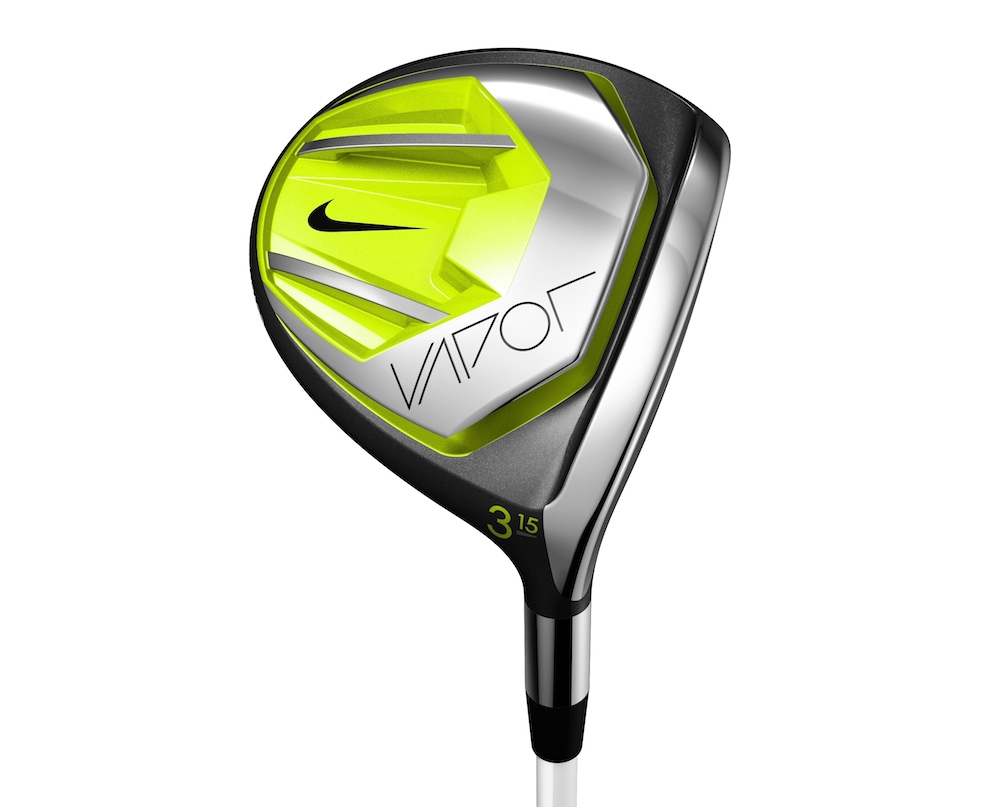
Nike Vapor Flex and Vapor Speed Fairway Woods

via GolfWRX - Golf news, equipment, reviews, classifieds and discussion


Nike’s Vapor Speed and Vapor Flex fairway woods are designed to fly longer and straighter than the company’s previous fairway woods, regardless of how golfers use them.

At the request of Nike Golf athletes, the clubs were made larger than previous models. The Vapor Speed in particular was made 25 percent larger, making it a great choice for golfers who prefer a larger face profile in their fairway woods such as Tiger Woods.

Vapor Speed Fairway Wood ($199)


Engineers were also able to drive the center of gravity (CG) lower in the Vapor Speed fairway woods by adding slope to their crowns. That change, along with the synergy of Nike’s FlyBeam-reinforced Covert Cavity Back Design and Compression Channel, raises launch angle, lowers spin and adds ball speed — the key to more distance.

Vapor Flex Fairway Wood ($249)

The Vapor Flex fairway woods have the same technologies as the Vapor Speed models, but they’re smaller in size and have Nike’s new FlexLoft 2 adjustable hosel, which is 30 percent lighter than the company’s original FlexLoft hosel. It gives golfers the ability to adjust loft 2 degrees up or down from the stock setting and choose one of three independent face angles: left, neutral or right.


Note: The FlexLoft 2 adjustable hosel is compatible with Nike’s original FlexLoft hosel. 

The Vapor Speed ($199) will be available in lofts of 15 and 19 degrees with Mitsubishi Rayon’s Fubuki Z 60 shaft (X, S, R, A and W flexes). The Vapor Flex ($249) will be available in lofts of 15 and 19 degrees with Mitsubishi Rayon’s Second-Generation Diamana S+ 70 shaft (X, S and R flexes).

Both fairway woods will be in stores on Jan. 30, 2015.

Specs


Scotty Cameron Futura X5 and X5R Putters

via GolfWRX - Golf news, equipment, reviews, classifieds and discussion


Oversized putters were once a rarity in professional golf, but not anymore. These days, they’ve become the norm, with as many as 50 percent of PGA Tour players using them each week on Tour.

Scotty Cameron’s new Futura X5 and X5R are a result of the increased demand for larger putters by the world’s best players.

“The Futura X5 mallet is for someone who likes the stability of a bigger head, the feel of a bigger grip and likes to look down and see more lines for alignment purposes,” Cameron said. “X5 is more of a mechanical shape where the X5R is a softer, rounder shape. There’s no right or wrong. Same performance, same weight, same feel. It all depends on what you like to look at.”

Futura X5


 Futura X5R


Both putters have a multi-material design that includes a 303 Stainless Steel body and a 6061 aluminum sole plate. The use of aluminum extends into the “wings” of the putters and allowed Cameron to move weight to their extreme perimeter. That improves a putter’s stability and resistance to twisting.

And there’s another, not-so-hidden benefit to larger putters.

“The bigger the head, the more lines you can add for alignment,” Cameron said. “We worked with many players on tour and in the Putter Studio during the development of X5 and they all told us the same thing: It adds confidence.”

Futura X5


Futura X5R


The X5 and X5R putters also have single-bend shafts with a higher bend point that make them face-balanced.

“The single bend came from taking feedback from the tour and working with players in the Studio. Double bends have been around for years and for X5 we really wanted to clean up the look,” Cameron said. “We had many players say they wished that the shaft leaned at their target or on their line, so we worked to find the proper offset and lean of the shaft so, at address, the bend lines up pointing right at your target. That was a key one because the mechanical-industrial shape of the head and the clean mechanical-industrial bend match perfectly. What I didn’t want was a heavy, flowing bend onto a mechanical head.”

Each model has a 10-inch Matador Red Midsize grip that weighs 77 grams.

“The grip can complement or kill the design of the putter,” Cameron said. “I know that sounds strange, but grips make a difference. With blades, it’s a little more handsy, a little more flowing, a little more feel. With Futura X putters, it’s a little more robotic, a little more square-to-square and this larger Matador grip complements the head very well.”

The Futura X5 and X5R putters ($349) will be in stores on Oct. 31. They both have Cameron’s Silver Mist finish are are available in lengths of 33, 34 and 35 inches. For lefties, the X5 is available in lengths of 33, 34 and 35 inches.

Click here to see in-hand photos of the Futura X5 and X5R from the PGA Tour.

Futura X5 Dual Balance


A Futura X5 Dual Balance ($399) will also be available on Oct. 31. It has an extra 50-gram weight located under its aluminum sole plate, which is counterbalanced with a 50-gram weight in its 15-inch grip that can help smooth out certain golfer’s strokes.

Stock length is 38 inches, but lengths of 36-to-40 inches in 0.5-inch increments are available by custom order.

Click here to see in-hand photos of the Futura X5 and X5R from the PGA Tour.


About 

Zak is the Managing Editor of GolfWRX.com .

He's been a part of the company since 2012, when he was hired to develop GolfWRX's front page. Since that time, GolfWRX has become the go-to destination on the web for golf equipment news, tour news, instruction and opinion.

Zak also developed GolfWRX's Featured Writer Program, which supports aspiring writers who want to improve their skills and allows established golf professionals to communicate directly with readers.

He played college golf at the University of Richmond, where he took too many strokes. Good thing he also studied journalism and creative writing.

You can follow Zak on Twitter @ZakKoz, where he's happy to discuss all the cool gear and insider info that's part of his job.


World Golf Hall of Fame announces class of 2015


via Compleat Golfer


Mark O’Meara, A.W. Tillinghast, Laura Davies and David Graham will be inducted into the World Golf Hall of Fame as the class of 2015.

The induction ceremony will be held in St Andrews next year during the Open Championship.

This is the first class to be elected by the Hall of Fame’s new selection commission, co-chaired by Hall of Fame members Arnold Palmer, Nancy Lopez, Gary Player and Annika Sorenstam.

“We are thrilled to welcome Laura, David, Mark and A.W. into the World Golf Hall of Fame,” said PGA Tour commissioner and Selection Commission member Tim Finchem.

“The new selection process provided a thorough examination of the candidates by a diverse, international group and we’re delighted with the outcome. Congratulations to the class of 2015.”

Mark O’Meara

Mark O’Meara established himself as one of the greats when he captured both the Masters and Open Championship in 1998. That season, in which he birdied the last two holes at Augusta National to pip Fred Couples and David Duval by a shot and outlasted Brian Watts in a four-hole playoff at Royal Birkdale, made the then 41-year-old the oldest player to have won two Majors in one season.

A.W. Tillinghast

Albert Warren (A.W.) Tillinghast, who died in 1942, designed over 250 golf courses, including iconic layouts such as those at Bethpage State Park, Winged Foot, Baltusrol Golf Club and San Francisco Golf Club. He also authored a great many books about the game.


The Black Course at Bethpage State Park is one of Tillinghast’s many revered designs.


Laura Davies

With more than 70 victories worldwide and four LPGA Tour Majors, Davies is considered by many to be the most successful female British player of all time. Davies has represented Europe a record 12 times in the Solheim Cup, playing in every competition from 1990 – 2011.

David Graham

Among his more than 20 victories worldwide, Graham claimed the 1979 PGA Championship at Oakland Hills Country Club and the 1981 US Open at Merion. Graham’s final round of 67 at Merion is regarded as one of the finest final rounds in Major championship history – even the Ben Hogan phoned him afterwards to congratulate him.


Tuesday, June 24, 2014

Treine o poder mental


O trabalho de reeducação da mente é algo possível com todas as pessoas, em qualquer que seja a área de atuação e o Método DeRose visa o desenvolvimento integral do indivíduo à alta performance, logo esse aspeto é altamente tido em conta. Com os golfistas profissionais ou amadores, o trabalho é todo ele desenvolvido com disciplina, investindo tanto tempo na mente como no seu treino físico e de aperfeiçoamento do swing. Desta forma, devemos fortalecer a nossa mente tal e qual um músculo através de:
  • mentalização : para criar objetivos bem definidos (nítidos como se fossem reais);
  • concentração: treinamo-la para aprender a pensar numa só coisa (usando cada vez menos o lado cognitivo) e com isso libertar o aspeto criativo e intuitivo do feeling e da sensibilidade;
  • meditação: supressão da instabilidade da mente. O uso da intuição.

É fundamental a mente serena e livre de emoções como o medo, a frustração ou a euforia (excesso de confiança). A sua concentração e força deverão estar sempre no máximo das suas capacidades, juntamente com  a capacidade de as manter em jogo integralmente, sem se envolver pela frustração de um mau shot ou pela exuberância de um momento mágico de golfe. Pense uma tacada de cada vez!

O golfe é um jogo que inspira prazer e descontração. Estamos rodeados de verde, ar puro, do sentido de liberdade e sempre rodeados de outros jogadores que sentem o mesmo sentido de diversão sempre que pegam num taco. Divirta-se e deixe-se envolver por essa emoção de prazer. É certo que qualquer tipo de emoção , negativa ou positiva interferirão na atuação da mente, mas faça-se envolver mais pelas positivas que trarão um resultado mais próximo à descontração muscular que necessita para manter a consistência do seu swing.

Veja só um dos erros comuns dos amadores: Já se imaginou contratar um professor ou ter mesmo um amigo que passa a maioria do tempo a criticá-lo e a julgar sempre que algo de mau lhe acontece? Pois bem, é isso que acontece com a sua mente na maioria das vezes quando está a jogar “sozinho”.

Fazer isso, é criar e reforçar o arquétipo mental de um derrotado e frustrado jogador de golfe. As técnicas do Método DeRose treinam-nos exatamente para que isso não seja um dos obstáculos. Não alimente a sua mente com pensamentos negativos do jogo, pois ela tenderá a replicá-los vez após vez e mais intensamente quanto mais pensar nisso.

Aprenda a esquecer imediatamente. “Mude de canal" e ponha em prática a teoria dos opostos que nos diz que no confronto de uma emoção negativa, para a ultrapassar, devemos pensar na sua oposta. Assim, qual o contrário de frustração? Confiança. E o oposto de raiva? Alegria. 

Gere intencionalmente imagens mentais (mentalização ou imaginação) positivas que vão transformar o seu jogo para melhor e simultaneamente concentre-se e mantenha a cabeça livre de pensamentos negativos. O golfe é um jogo de confiança!

Ponha em prática o exemplo seguinte de um dos vários exercícios que pode executar: 

Todos os dias, antes de se deitar, sente-se numa posição confortável e feche os olhos. Escolha um local seco, sossegado e agradável. Durante os primeiros 10 minutos pense em tudo o que de positivo aconteceu desde que se levantou, deixe que um ligeiro sorriso seja esboçado no seu semblante e tenha atenção para descontrair a testa… nos 10 minutos seguintes não pense em nada, deixe-se envolver pela sensação do vazio e pelo prazer da leveza de não pensar. 

Para funcionar tem de aplicar o princípio de treino de qualquer atleta vencedor: disciplina e constância diária. 


Aplique o treino mental em conjunto com o físico. Ambos são indissociáveis … seria como querer colocar um motor de um F1 num chassi de um carro de turismo ou o contrário conforme o caso.